Maradona the Manager
The gathered press waited at the Argentine football headquarters in Buenos Aires. The squad announcement for the 2010 World Cup was about to take place. Finally, an hour late, the Argentina head coach Diego Maradona rolled in driving his Mini. Met by a swarm of journalists and photographers, his car became engulfed in the mass of humanity.
A photographer succumbed to the pushing and shoving. He fell into the path of the vehicle, which rolled over the snapper’s leg. The driver was incandescent: “What an arsehole you are. How can you put your leg there, where it can get run over?”. It was no ordinary start to a national team press conference, but then, Maradona was no ordinary national team coach.

Wild-eyed Celebration
Club Social Deportivo Textil Mandiyú is a name that doesn’t exactly roll off the tongue. Workers from a textile factory in Corrientes, Argentina founded the club in the 1950s. By the summer of 1994, the club were in financial dire-straights, which resulted in its sale for $2m. With the new owners looking to make an impact, they couldn’t have chosen a more high-profile manager.
A few months earlier, Diego Maradona was sent home in disgrace from the World Cup. The legendary number 10 had tested positive for ephedrine following Argentina’s opening match against Nigeria. The results of the test didn’t come to light until five days later. During that time Maradona had played in his country’s second group game against Greece.
That game against the Greeks provided one of the most enduring images of El Diego. His wild-eyed celebration, following his superb goal, was as eye-catching as the strike itself. In hindsight, there was a darkness to this ray of light.
In a press conference announcing his expulsion from the tournament, Maradona seemed to shift the blame. He suggested some kind of conspiracy: “They’ve cut my legs off,” he said in reference to FIFA. A short four months later and the national team legend was in a club dugout.
His appointment at Mandiyú was based more on his fame than on his competency as a manager. Fellow World Cup winner Sergio Goycochea joined him at the club. There would be no glory this time.
88 Days
Maradona’s time at Mandiyú was short. As is often the case with the majority of publicity-stunt style managerial appointments. A little over two months was hardly a great start to a managerial career. At the same time, it wasn’t exactly time enough to prove his abilities. He wouldn’t have to wait long for his next opportunity. That arrived soon despite a meagre 88 days at the Argentine minnows.
Racing Club appointed the mercurial Maradona just a week after his departure from his first managerial role. Incredibly, he only managed 79 short days in charge of Racing. His party lifestyle seemed to get in the way of his managerial duties. Old habits would die hard it seems when it cames to Diego. It looked as though management wasn’t ever going to fit in with his playboy lifestyle.
Maradona had another chance to prove his managerial nouse three years later. He failed to notch up even six months of combined experience from his first two appointments. It was only natural that his next job would be as national team manager, of course. La Albiceleste were struggling in qualification for the World Cup in South Africa in 2010. Despite more experienced and, frankly, respectable contenders for the job, the Argentine FA called on their greatest son.
In his time away from the game, Maradona’s had suffered from health problems. He almost passed away in 2000 due to a cocaine overdose as his debauched lifestyle caught up with him. The legendary forward suffered a heart attack in 2004. It was said to be brought on by an addiction that began during his time at Barcelona. Alcohol abuse had caused liver disease and obesity. This led to gastric bypass surgery in an attempt to return Diego to a healthier weight. It seemed to have worked.
New Argentina Manager
The new Argentina manager took charge of his country for the first time in a friendly at Hampden Park. It was the venue where he had scored the first of his 34 international goals. That came against Scotland in a 3-1 win in 1979. The omen seemed to be a favourable one for La Albiceleste. The visitors beat Scotland thanks to a solitary Maxi Rodríguez goal. A three-game winning streak to start his reign followed. It was something of a false dawn as a humbling was just around the corner.
Bolivia’s Estadio Hernando Siles in La Paz is a notoriously difficult place to play football. The stadium is high in the Bolivian mountains. The thin air has wilted many a visiting side over the years and Maradona’s team were about to buckle spectacularly. A 6-1 defeat on the night provided Argentina with their heaviest defeat in more than 60 years. Maradona sympathised with the Argentine fans after the game: “I suffered with them. Every Bolivian goal was a dagger in my heart.”
The defeat obliterated Argentina’s form as they lost two of the next four games. That left them in fifth place in the table and outside the qualification spots. To miss out on the competition as former winners would be inconceivable. At the same time, it would surely cause irreparable damage to Diego’s career in the dugout.
Two victories in the final two qualifiers earned Argentina a spot at the South African showpiece. Late goals against Peru in Buenos Aires and Uruguay in Montevideo spared their blushes. It also spared Maradona the ignominy of failing to take his country to the World Cup. The competition he once led them to victory in.
Pressure
The pressure of that potential failure had clearly been weighing heavily on the stocky shoulders of the boss. In an expletive-filled post-match press conference, Maradona took aim at his critics in the press. “Suck it and keep on sucking it,.” That was his less than eloquent words as he grabbed his crotch before the assembled media. His post-victory behaviour earned the manager fine and a two-month ban from all footballing activity.
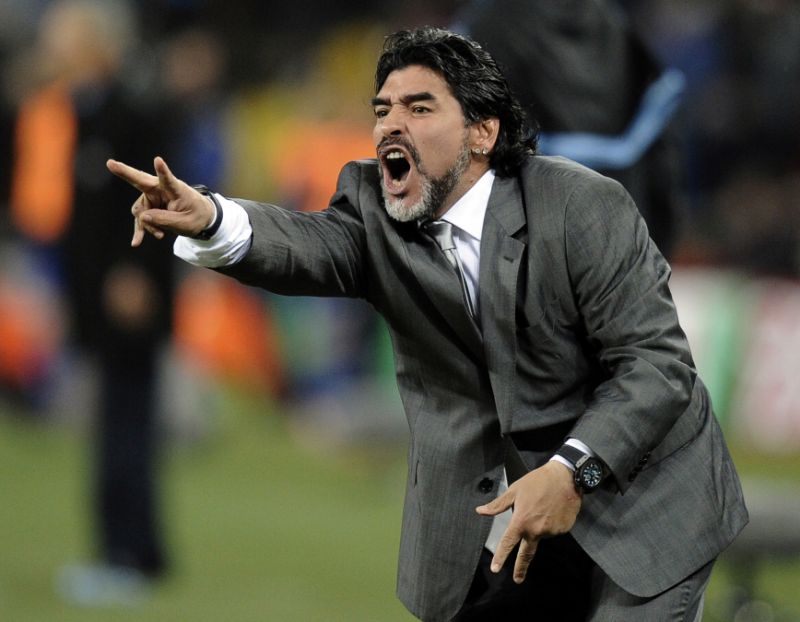
Press conference controversy would follow Maradona in the lead up to South Africa. Indeed, the incident with the photographer at the squad announcement was a preview of what was to follow. There were high-profile omissions from the squad. The exclusion of Javier Zanetti and Esteban Cambiasso had not been received well in the Argentine media. The manager stuck by his decision in typical fashion. “I don’t care what you people think of me as a manager. I couldn’t care less. I’ve got my 23 players and I’m ready to die with them.”
World Cup in South Africa
As the tournament began, Maradona’s appearance had changed somewhat, with the addition of a dark beard, complete with greying patches. Perhaps this was a homage to one of his heroes, Che Guevara? The explanation was, obviously, far more bizarre. “I grew it because my dog almost ate my mouth and left me with a big scar.”
Argentina’s on-field campaign started off in a far more understated fashion than the media sideshows. Defender Gabriel Heintze’s early goal was enough to see off a tricky Nigeria side in the opening group game. That was followed by a far more impressive 4-1 win over South Korea which was inspired by a Gonzalo Higuaín hat-trick. A 2-0 victory over Greece saw La Aalbiceleste through to the knockout phase as winners of Group B.
It was back to the press conference soundbites for Maradona in the lead up to the last-16 game against Mexico. The ball, it would seem, was of most concern to the manager: “This ball is useless. It’s impossible to control.” His team didn’t seem to have too any problems with the ball against Mexico. They ran out 3-1 winners in their most impressive performance of the tournament.
The quarter-final would see the end of Argentina’s run. A comprehensive 4-0 defeat to Germany brought the curtain down on their campaign. Maradona admitted his time in charge may be coming to an end. “I may leave tomorrow.” It was announced that he was to be offered a new contract. Later, it was decided by the AFA that Maradona’s contract would not be renewed.
Unpredictable Return
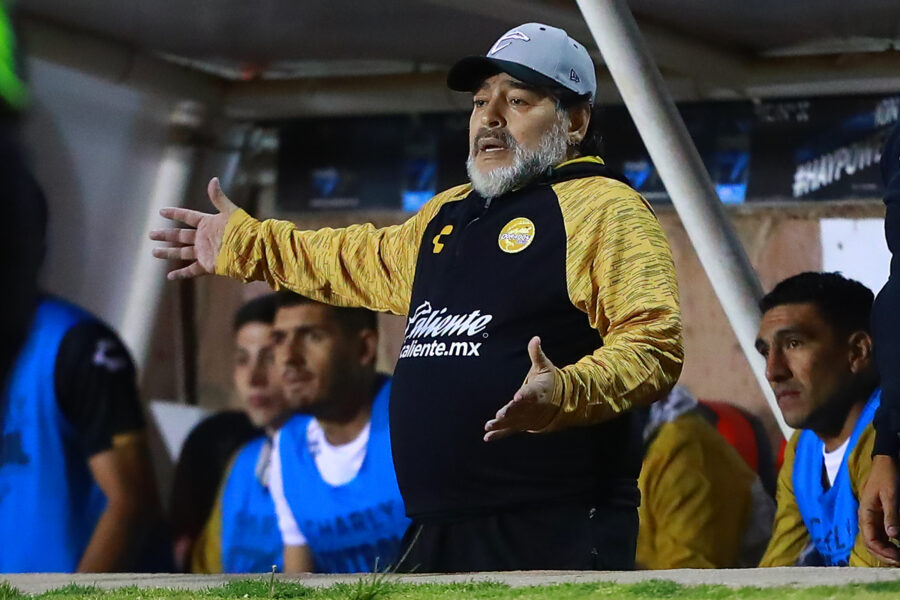
After a year away from management, Maradona returned in a typically unpredictable fashion. Dubai-based club Al-Wasl secured the legend’s signature ahead of the 2011/12 season. The club announced ther signing in grand fashion. “A momentous development that will see the football legend lead the team for the next two seasons”. Except he didn’t.
A board change after Maradona’s first season in charge signalled an end to his time in charge. It was a campaign that witnessed more off-field talking points than on-field success. At the time, Al Wasl’s goalkeeper, Majid Naser, was serving a 17-game domestic ban. He had slapped Al-Ahli coach Quique Sánchez Flores during a match between the sides. Despite that, Maradona decided that the ‘keeper should play in the Gulf Champions League.
The decision to play the ‘keeper in the midst of his ban and the controversy surrounding it wasn’t greeted well. El Diego was criticised for the decision and his leadership. This was further called into question when his decision to play Naser backfired spectacularly.
Al Wasl held a 3-1 lead after the first leg of their tie with Al Muharraq. The goalkeeper’s questionable temperament then cost his side. Naser was sent off for a headbutt as Al Wasl lost the tie. Maradona’s decision to stand by the banned ‘keeper coming back to haunt him in the worst possible way.
The writing was on the wall for Maradona at Al Wasl. He was involved in an altercation with fans of the club during a game. He had seen a group of supporters abusing his partner and family members. The club ended the season a disappointing eighth in the league and without any silverware. After finishing sixth prior to Maradona’s arrival, it was felt they were moving backwards. And they probably were.

No Regrets
On leaving Al Wasl, Maradona didn’t appear to have any regrets. “It was a fantastic experience and I hope I will be back soon.” He then spent some time on the coaching staff with Argentine club CD Riestra. His return to management was to come back in the Middle East.
Fujairah SC were hoping to return to the Arabian Gulf league after spending two seasons in the division below. Diego was their choice of manager to lead them back to the top league. He signed a one-year contract. The expectation was that he would lead the side back to the top-flight at the first attempt.
Things didn’t go to plan, however, and Fujairah missed out on automatic promotion. Confusion shrouded the Argentine’s departure. The breaking news suggested that he had been sacked. It was later reported that he had left by mutual consent. Finally, that he wasn’t leaving after all.
Ahead of the 2018 World Cup, Maradona offered to return as manager of Argentina during their qualification struggles. He gave Lionel Messi some advice ahead of that competition. “I would advise Messi to keep playing. He has to forget about critics, if he can win the World Cup or not.” Sadly, Maradona passed away before Messi lifted the trophy four years later.
From a playing perspective, perhaps Maradona was the only person qualified to give Messi advice. If the Barcelona superstar has any plans on moving into management, though, he might be better off seeking advice elsewhere. Chaos and controversy seem to best describe Diego Maradona the manager. Both were present in his playing days. Unfortunately for the Argentinian legend, his talent on the touchline never saw him reach the pinnacle of the game. In contrast to his abilities with the ball at his feet.
This article previously appeared in These Football Times – Maradona: The Managerial Diaries