

Sophie Lawson – Toxic Positivity and Covering Women’s Football
Sophie Lawson has been one of the most popular voices covering women’s football for almost a decade. Always a great person to follow on social media, Sophie can inject humour into her coverage as well as quality writing. After recently announcing that she was stepping away from covering football, I wanted to catch up with Lawson to find out how much the women’s game has changed from a media perspective and why she has decided to leave.
Blog posts
It was almost ten years ago that Sophie started writing about football. What got the ball rolling for her was being at a match and watching a manager struggle on the sidelines.
“I have absolutely no training in it, so it has been a learning curve. I went to a game on 12th of July 2015 and because it was it was a small ground, I could see the coach. It was 1-1 and you could see he was dithering on making a change. His indecision crept over to the entire squad. They didn’t know if they should try and push for a winner or hold for the draw.
I thought it was really interesting. They ended up losing 2-1 because the other coach pushed and made the right changes. I thought someone should say something about it because it was it was palpable. So, I ended up just writing a blog post about it and then I started blogging about every game. Then I kind of kept going and someone said do you want to write for us? You won’t get paid. But, we can put you in the press box. Then everything kind of just snowballed and picked up over time.”
I’ve got some thoughts
“I started getting some paid work and started traveling. It really was just a case of ‘I’ve got some thoughts about this game.’ I don’t really like big crowds so I didn’t go to too many men’s games. That was my first women’s game, my first game for a long, long, long, long time. It was local and it was accessible, and kind of just spoke to me at the time. I had watched a lot on TV or streams before then. It became a good outlet to focus on when I was in quite a serious low and depression. I never expected to have a job or to have a big part of my life being so football centric.”
Growth of the game
The women’s game has grown exponentially in England during Sophie’s time covering women’s football. The growth on the pitch has not always been matched off it though. As crowds and popularity have increased, the media coverage has not necessarily followed.
“I think there is this sort of misconception that as the crowd grows, the media grows, right? That is not really the case when you don’t have dedicated writers at certain papers or certain outlets. That usually leads to someone covering the English leagues in England for example, and trying to have enough of a reach to cover everything else too.
If you are writing about Man United men, you’re worrying about Man United men’s team only. Whereas in the women’s game you must be there for every team in the league. What has kind of grown over the last few years is the core press pack, trying to help each other out. At the end of the week you’ve got all your press conferences. They overlap because you’ve got twelve teams all trying to do it at the same time. There has to be collaboration to help each other cover everything as there isn’t enough people to cover it all. I think what has grown whilst more people have come in, is that collaboration.”
Rise of Distrust
“There is maybe more chance to get a full-time job in the sport now and only be dedicated to women’s football, but is still rarity. You are still trying to push for column inches. You have also had the rise of the content creator and different forms of media around the game as well.
A few years ago, I could go to an Arsenal game. To do my post-match the press officer would be fine if you just grabbed a player. She would trust you. Now, everyone gets one player and you get four questions so it is a completely different world. Everything has been brought in-house and everyone said, well this is how we do it in men’s football. So now this is how it is. You have got that kind of rise of distrust from players as well. It comes over from the men’s game. You think ‘I’ve known you for ten years and you know I’m sound and not going to try and trip you up.’ It feels like it has gone the way of the men’s game in that respect.”

Huge Strides
There have undoubtedly been huge strides made in the coverage of women’s football in Sophie’s time in the game. Her’s is not an unfamiliar story though as with ten-years experience, there are still not enough full-time jobs to go around.
“When I first started there were zero jobs that were full-time. Now there is four or five maybe? You look at Suzy Wrack at the Guardian who is this phenomenal journalist and who does all these big exposés. When she first started at the Guardian, she was on a desk doing layout stuff, and that was her point of ingress then to pitch a sport blog. That was one piece a week that kept growing and then the Telegraph set up their full-time woman’s job. Suzy went for it and she got down to the last three. She then used that as leverage with the Guardian for them to create their first ever women’s football job. They now have Tom Garry as well working alongside her and a few different freelancers.
At the same time other papers will say you need to split your time with men’s football. A lot of places do not see the value in it, but it has come a long way in the last decade. It is never going to be the same sort of level of as men’s football because that is just at total oversaturation.”
Toxic Positivity
When it comes to women’s football, in the online space in particular, you don’t have to look hard to see outdated, misogynistic and ignorant views and comments. This has led, in my opinion, to those who cover the women’s game being a little over-positive and averse to any kind of criticism. I was keen to hear Sophie’s views on that.
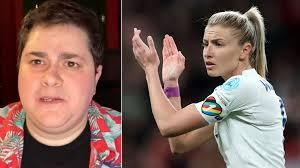
“I wrote a whole article about it a couple of years ago. Toxic positivity. I think it stems from a few different places. I mean, it is every time you post something about women’s football on social media and even every BBC article gets it. In the replies you get ‘back to the kitchen’, ‘no one cares’, and you also have the emptyheaded, sexist responses. You at no point want to criticize because you will be seen in the same kind of sphere as people who don’t care about women’s football.”
A Grown-up Sport
“I think the women’s football community can be quiet on criticism. It has grown but for a long time it was very close. Everyone kind of cheers on everyone else, you have really got a community in football. Especially the amount of queer fans and neurodivergent fans. It is just a safe space and the last thing you want to do, because the sport and the players feel they are a little bit more personal to you, is criticise it. It can feel like some are too close to really criticise. You have also got the side of it that people who are pundits are often former players. They are friends with players and don’t want to be over the critical of people that they are close with.
So, everyone becomes a cheerleader, every player is world class, every goal is a rocket. It feels like that is doing a disservice to the sport. It is almost like, you know, your kid has drawn a terrible picture and you are like, ‘oh my God, we have another Picasso here.’ It’s a grown-up sport. We need to be able to treat it like a grown-up sport, especially as it is now a profession as well.”
Ritual shirt signings
Another thing that is changing around the top level of women’s football is the relationship between players and supporters. The players always felt a little more relatable and closer to fans than in the men’s game where players were far more unreachable. As popularity grows and crowd sizes too, is it inevitable that the relatability and closeness falls by the wayside?
“Yeah, I think it was always going to happen so. You go to any game anywhere and you have the ritual shirt signings and the autographs afterwards. As the crowds were growing that was becoming less and less viable. There was a lot little kids who were egged on by their parents too. One of them apparently told their kid just to run at Ella Toone’s car to try and get an autograph. This kid almost got mown down. So, then Man United changed some stuff around player access but I think it was always growing in a way where you were going to lose so much of the connectivity.
You can also find strange atmospheres at a women’s game. I remember someone who was in it for a long time always spoke about how quiet it was. Even if it was Wembley with 50,000 fans for the FA Cup final. I get the fans are not as noisy or they don’t react in the same way. Sometimes they just try and create noise for the sake of it and it just it feels inorganic. Men’s football evolved organically, whereas women’s football keeps getting boosted with steroids, and then it feels contrived. It hasn’t had a normal maturation period.”
Stepping away
Personal circumstances have led to Sophie’s decision to step away from her work in women’s football. It is a sign of where the game is at that there is no money in it for talented people like her to cover it. Sophie has racked up some serious mileage in her time too, leading to the nickname of the ‘Attenborough of women’s football.’
“I had a nice little job with the ESPN. Then they decided to not extend my contract, which was fine, their decision. Since I had a steady job with them, I have taken on some more expenses at home. Suddenly not having that income coming in can be tough. I spent a few months trying to find work but it is that situation, as it has always been, in that the you can get work if you do it for free or for ‘exposure’.”
Attenborough of women’s football
“I never had any training as well so I just couldn’t find the work and then it just becomes a bigger and bigger thing. It feels a bit weird because it has been so much of my life over the last decade. I was doing my final mileage the other day. I think I am close to 300,000 miles. A lot of that was on Ryanair flights and Megabuses, that was what it took back in the days of not getting paid for it. You had to find a cheaper way of getting around. I feel like I have done more than my fair share and I think that is also what has taken some of the enjoyment out of it.
I enjoyed the travelling although I am not a good tourist. When I started traveling for football I had never been to Scotland before, I had never been to Germany. I have got about six different languages going on Duolingo and that is all because of football. I started Swedish, because I covered a lot of Swedish football and it was useful. It is funny because I don’t think it has necessarily changed me as a person, but it’s kind of opened up all these doors that maybe I never would have opened before. It is a bit weird to reconcile with the thought of leaving.”
Follow Sophie on X – https://x.com/lawson_sv