
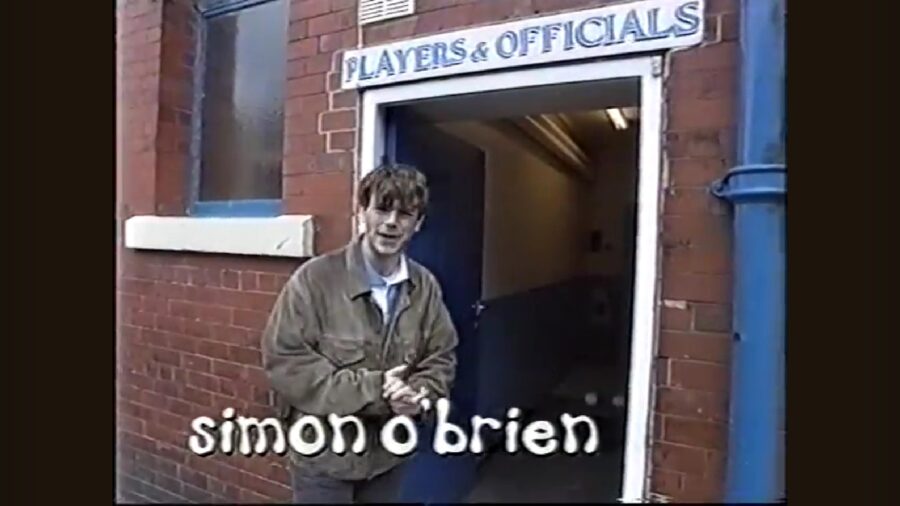
Simon O’Brien – Standing Room Only
When you think about football tv shows in the 90s your mind probably goes straight to Fantasy Football League, Gazzetta Football Italia or the early years of Soccer AM. Standing Room Only was the forerunner of all of those. A magazine show with a mix of serious features, comedy interludes and a cast of future stars. I spoke with the show’s main presenter Simon O’Brien as we looked back fondly at a show that was ahead of its time. This may well be the only football article you’ve ever read featuring Janet Street-Porter, Dennis Bergkamp, Alistair McGowan and a Daley Thomson hat-trick…
A Brookside departure
Part of the original cast of Channel 4 soap Brookside, O’Brien was a household name in the UK. His character Damon Grant became one of the most popular on television at the time. So much so, that when the actor told producers he wanted to leave the show, they created a three-part spin-off series which ended with Damon’s murder. Simon explained his move from acting into presenting in the years following his Brookside departure.
“I left Brookside and at that time typecasting still existed. So, I realised that television acting jobs might be a bit scarce. I did some presenting work on kid’s telly. One show was called ‘Move It’, where I tried out all different kinds of sport. The other children’s show I did was called ‘I Can Do That’. It was all about kids getting to try what they wanted to do when they grow up. The presenting thing had really kicked in at that point. ‘Standing Room’ was just the next thing along really.”
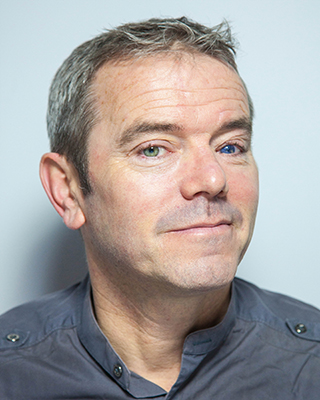
Youth programming
Janet Street-Porter, for those unfamiliar with her, is an English journalist and broadcaster with a history of producing and editing television programmes. Street-Porter isn’t necessarily someone you would associate with football. It was under her guidance that Standing Room Only was created.
“Janet Street-Porter set up a branch of the BBC called Def II. The programming was all youth orientated. It was there that someone came up with the idea of Standing Room Only. They had decided to do a magazine programme. What Janet did was open the doors to people from different backgrounds who wouldn’t normally get into television. Suddenly, there was an office full of us with this remit to make a football magazine show. We had the name and the logo that said, ‘sick as a parrot’. They just told us to go off and find some stories.
That gave it a really, kind of anarchic feel. They just trusted us to go and get on with it. We had three good female journalists working on it which wasn’t the norm for a football show in those days. We had a good mix, and it was before it’s time really in that respect. I’ve always believed with television that if you enjoy making it then people will enjoy watching. We had a riot on that show. We were all in our early twenties. They let us loose on the world of television and told us we could do what we liked. The result of that was that some of it worked and was really good, and some of it never.”
Comedy segments
The shows anarchic feel and comedy segments certainly laid the tracks for the likes of Fantasy Football League to continue down. ‘Sepp Maier’s Comedy Shorts’was a regular comedy segment on the show. It featured comedians Rob Newman and future Fantasy Football presenter David Baddiel. There were other comedy turns on the show including Rory Bremner and Alistair Mcgowan. The shows never shied away from having a laugh at others expense. That is something which O’Brien felt would prevent it from being made today.
“Alistair McGowan started out on the show, that was his big break. David Baddiel as well was on there. Everyone involved was just real football supporters and I think that came across. We had a reunion about ten years ago. We watched a few of the shows and we were literally cringing at how much some of them looked like home video footage. Some were really slick, but others were rough round the edges shall we say.
The pieces on the shows were irreverent. I know for fact that Standing Room Only couldn’t be made today. We were constantly taking jabs at the authorities and the clubs. Imagine trying to do a show like that with the likes of Sky and the Premier League in the background. We’d spend ninety per cent of our time talking to our solicitors. We kind of just got away with it as we were just cheeky and up front. It wasn’t until we had been going for about three seasons. We started getting questioned about some of things we were saying. Luckily for us we had the backing of the BBC.”
Serious football journalism
Whilst cheeky jabs at authority and comedy sketches were always there, the show uniquely balanced them with serious pieces of football journalism. A great example of this was when Simon travelled to Dresden to report on a group of fascist supporters. The Berlin wall had recently fallen. The team had decided to follow up on reports of a rise in fascism amongst certain fan groups.
Fascist supporters
“We were digging out stories that were difficult to find details on. The one in Germany in particular. I remember saying to the director ‘if this turns out to be six naughty boys then we can’t say the far right are taking over East German football’. When we went it was the first year that Dresden had played in the league after the fall of the Berlin wall. They were one of the first East German clubs with good enough facilities to get into the Bundesliga. We went over to watch them play Bayern Munich in Dresden. We walked into the stadium and about a third of the home end was a sea of iron crosses and swastikas. It was just nuts. I remember walking into the stadium and on seeing that, turning to the director, and saying ‘ok, the story’s on’.
We were working with a crazy German film crew, and it all kicked off outside the ground after the match. All the riot police started to arrive, and our cameraman started to run towards all the fighting. It was obviously his job to pick up the footage, but I was actually attached to him by my microphone. He was sprinting towards this running battle, and I was trailing behind by my mic. He ended up with his head cut open, but he was just delighted he got the shots he wanted.
It was a really cutting, serious piece that we had unearthed. We were very nimble because our boss was an old hack journalist who could smell a good story. We were always looking for that serious subjects. The fact we had him in charge meant he would just jump on stories and look to cover them before anyone else did.”
Big name guests
Another string to the show’s bow was the ability to feature interviews with some of football’s biggest names. Michel Platini, Johann Cruyff and George Best were all interviewed. The famous fan genre was also covered with features including DJ John Peel and tennis player Yannick Noah. There were so many great names to choose from when I asked Simon who his most memorable interviewee was.
“One guest in particular for me was outstanding and that was Denis Bergkamp. We went to cover the Ajax academy who were just miles ahead of their time back then. They were the first to realise that only five percent of the young players they had would make it as footballers. They had them study for their equivalent of O-levels. If they didn’t pass, then they didn’t let them play. To try and suggest that to footballers now would just be nuts. What you got there was intelligent and articulate players.
At the time Barcelona had been trying to sign Bergkamp and had offered about three million quid for him. At that time very few transfers had broken the million-pound mark like that. I was chatting to Bergkamp and said to him ‘I’ve heard you’re a target for Barcelona, you must be chuffed. When are you going’. He told me he wasn’t going to be going. I thought, why would you pass up the chance of lifetime to move to a club like that. I asked him and he said that he had been with Ajax since he was ten. He felt that he owed it to them to stay longer before moving on. I wish Wayne Rooney had done that for us at Everton.”
Integral to the style
O’Brien plays down his importance to the show, but he was integral to the programme’s style. He looked like someone who had just walked out of the Gwladys Street End at Goodison Park. That was true to an extent in that he is an Evertonian. Simon describes some of his work on the show as ‘rough round the edges’ but he is in fact a knowledgeable and engaging host. He also came across like he was up for a laugh and that often came across in his interviews.
“I think my best question in any of the interviews came when we were down in Marseille. They had just got done for some kind of dodgy dealings and match fixing. So they were going to be relegated. Everyone had turned up to ask all these difficult in-depth questions of the management and the owner. In the middle of it I got my question in. I said, ‘you’re obviously going to lose Basile Boli now so can I have him for Everton’. Everyone in the room was laughing. You’d get thrown out for that nowadays. We had more freedom on our show as people just didn’t see us coming really.”
The ‘Supporterloo’
Those that remember the show often recall one segment, the ‘Supporterloo’. A Portaloo was placed outside a random ground before a match. They encouraged fans to enter the converted toilet and vent their spleen on whatever footballing subject they wanted. It was an early example of fan-led content.
“The ‘Supporterloo’ and they were just literally in a Portaloo. The way fans were spoken to on television was always formalised before that. It was usually outside the ground, but they only got asked pre-set questions. On our show they just got in the loo. There was nobody else in there so they could just press the button and say whatever they wanted. I think that gave them the bottle to really have a go at their own club. You couldn’t really do that surrounded by people standing at the gates of the ground. It seemed like a witty little drop in. But, it actually gave fans that platform that never really existed until that point.”
Influential
The show ended after four seasons and thirty-two episodes. Long after the show ended you could see its influence. From Soccer AM to Danny Dyer’s ‘Real Football Factories’. A direct line could be drawn from Standing Room Only. Its former presenter looks back fondly on the show. He still acts and presents but his football career isn’t as high-profile as it once was.
I’d love to do something in football again. I’m not sure I could behave myself with the polished coverage you get now. If only we could do Standing Room Only again now. Without a bank of lawyers, we’d just never get away with it. My football career has gone in a different direction now anyway. I coached my daughter’s football team for five years. I must give a shout out to them, Woolton FC. The girls in the team all come from a nice area. I unashamedly taught them the darks arts I learned as an average left-back.
I had an outing at Wembley before the Coventry against Tottenham Cup Final. They had a celebrity match on the pitch before the game. Daley Thompson scored a hat-trick for our side, so I think that was the pinnacle of my playing career. When I get the chance, I do get along at watch the Blues for my dose of depression.”
Simon O’Brien’s website can be found here: http://simonobrien.com/