
Amy Walsh – Canadian Women’s Football
When it comes to the subject of women’s football in Canada, there are few more qualified voices than that of Amy Walsh. The 102-times capped international represented her country at two World Cups and an Olympic Games. I spoke with Walsh after the scandal that marred Canada’s Olympic Games this summer and ahead of the launch of the country’s first professional women’s league in 2025.
Sporting childhood
Canada’s two national sports are ice hockey and lacrosse. Throw in American football, baseball and basketball and it is fair to say that football (soccer) wasn’t high up the list when Amy Walsh was growing up.
“I come from a big family of modest means. My older brother was five years older than me and he was my earliest role model. He is why I wanted to play football. I have twin sisters two years younger than me and by youngest sister is five years younger. Our municipality offered a deal that our parents paid for which made sports affordable and accessible. We did all kinds of sports. I did ridiculous things like barrel jumping and speed skating. My parents encouraged us and they were always super supportive. Sport was valued along with that sense of family and belonging. The importance of being valued was instilled in me from an early age.
Soccer was my love. It was my passion more than the other stuff. I was grateful to be able to play the other sports. They all leant something that helped me become a more well-rounded athlete. We played Futsal in a nearby gym. In six months’ time my technique went from below average to really, really good. I worked hard and the Futsal really helped springboard myself on to provincial teams. Then I moved to the under-twenty national team a couple of years later.”

Footballing journey
It was the beginning of a footballing journey that would take Walsh from playing for the University of Nebraska to representing her country over a hundred times. There can be few more qualified than Montréal native when it comes to the future of the women’s game in Canada. A new dawn looms in April of next year as the Northern Super League kicks off. A move to professionalisation that is long overdue according to Walsh.
“They expanded the World Cup to thirty-two teams. Canada and Haiti were the only two of those nations that didn’t have a domestic pro league. I found that pretty shameful. It was embarrassing from a Canadian perspective. A country that culturally has never had a football ban like in the UK. There was always an acceptance of women being able to participate in sports here.
In the US and Canada it was almost like they didn’t think you would succeed beyond an amateur level. They felt like ‘you can do it, but only up to a point.’ I feel they were maybe more open to the idea of professional football for women at these established clubs in Europe than they were in US and Canada. In Canada we aren’t even there yet. The NSL is going to be kicking off next year which is really exciting.”
Learning from mistakes
It isn’t an easy prospect attempting to launch a professional league. The NSL need only look over the border to their American neighbours. There were multiple attempts at launching a women’s league before the NWSL finally took off. If they can learn the mistakes of the NWSL’s failed predecessors the rewards are clear. The women’s game in the US is booming like never before.
“We want to set a high standard early on. It’s going to be competitive in terms of salary. On the pitch it might take a bit of time to get there because of the reality of drawing the best talent. We’ve always had to out-source our own talent. If you wanted to play at a high level you had to go elsewhere. If you didn’t have a passport your career was just done. The exciting thing now is that finally that will be an option for Canadian women. They can keep playing here at a professional level.
You look at the US and there were a couple of attempts there before NWSL got to the point it is at now. It really is firing on all cylinders in terms of new broadcast deals and the investment in individual franchises. We had a league in Canada that was called a semi-pro league. It was the furthest thing away from being professional. They never attempted professional circuit.”
Diana Matheson
The formation of a men’s professional league didn’t assist the establishment of a women’s version. As with much of the good work that goes into growing women’s football, it fell to a player to do the work themselves.
“The men’s domestic pro league was put in place in 2019 in Canada. There were never any efforts to start a women’s league in conjunction with it. For me, that just didn’t make any sense. Until the men qualified for a World Cup in Qatar, the quality of the women and what they had won upheld the national team programme. That remains frustrating. I could give you another few choice words in addition to that!
To me it just seems obtuse not to develop a league for women as well when setting up the men’s league. It took Diana Matheson, who scored that bronze medal winning goal against the French in 2012. She went and got her qualifications and a UEFA course and spearheaded the whole thing. Finally, a women’s pro league is coming but it took a former player to do it. That to me is a big indictment on the leadership of Canadian soccer.”

Drone scandal
On the subject of the Canadian soccer leadership, I couldn’t let our conversation pass without talking about the drone scandal that surrounded the country’s Olympic campaign this year. Canadian officials, including manager Bev Priestman, left the tournament in disgrace. It was found that drones had been used to spy on their opposition’s training sessions. Walsh thought about the Canadian players when she heard about the situation.
“The unethical and unsporting decisions and actions of the staff put the players in a position where they were having to perform in spite of something, again. The players were being forced to defend their own integrity and reputation. I was covering the tournament in the media and I was just reeling. It took me back to all the things you have to fight for as a female athlete.
I remember being on the phone as a player in the leadership group to Canadian soccer representatives negotiating our payout for the Olympics. We got told we wouldn’t be getting paid the night before our opening game against Argentina. So, then we had to go back and relay that information to the team on the eve of the first match of the tournament. That is not ideal preparation. It brought back memories of that thinking about what the current players were going through.
It was devastating for me that they were having to compete under the cloud of that. I really felt for them. I remember Diana Matheson said ‘they can take our six points but we’ll just run the table and get another nine.’ That is exactly what they did. I felt a sense of immense pride for what they accomplished. I hope the Federation can get passed this without their reputation being irreparably damaged.”
Olympian
The incident would have cut a little deeper on Amy given her past as an Olympian. Playing at the Beijing Games in 2008 is a highlight of her 102 caps. As are her appearances at the World Cup in 1999 and 2007.
“I remember in my yearbook it asked ‘probable destination’ and I wrote women’s World Cup. I must have been about to turn sixteen. Looking at it, it’s a little bit arrogant that I could envision myself as part of a World Cup team. The World Cup for me always held special significance. We didn’t have cable television so I never got to see that much soccer growing up. I wasn’t exposed to a whole lot of football. We got the odd ‘FourFourTwo’ magazine from our Scottish neighbours who lived up the street.
I would watch the men’s World Cup and I have vague memories of seeing the men’s team play at the eighty-six World Cup. We watched the Olympics too just because we loved sports. Being an Olympian was something that I viewed as being the pinnacle of sport. I guess I never expected to be there with the Canada soccer team. The fact that I got to go to both and experience both of those huge events wasn’t lost on me in terms of the achievement.”
Finish on a high
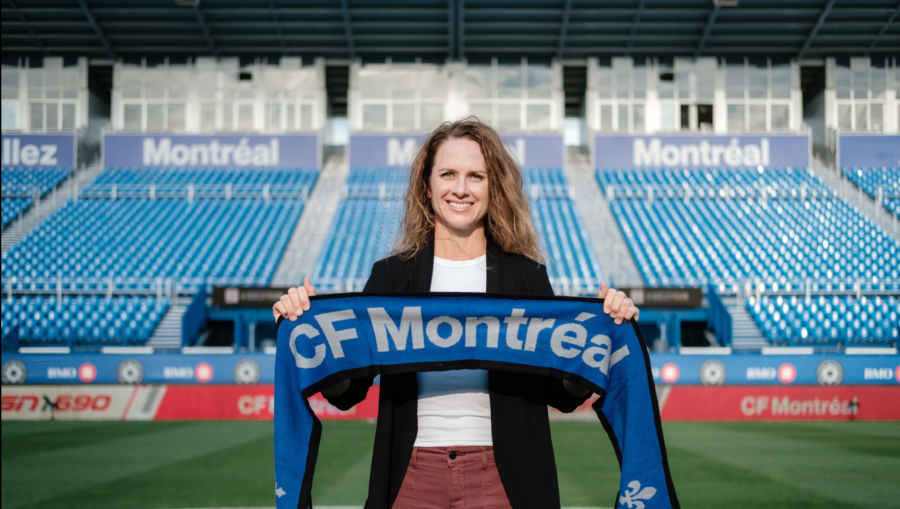
With the negativity of this summer’s Olympic scandal in the past, we finished our conversation on a high. Amy’s enthusiasm and excitement for her work with CF Montréal as they prepare for the launch of the NSL is evident. She described how she got involved and the important it is to get the launch right.
“I started just helping my friend out. Before the investors came to the table I was sitting on the football committee, figuring out competition manuals and things that like from a broader league perspective. Then with Montréal it was helping them unofficially just helping them out with that footballing vision. We look at what the talent was like here, what that pipeline of talent looked like. We looked into training facilities, infrastructure and the ‘in the weeds’ stuff right through to branding and kit which is going out very soon.
There are benefits in coming into an established men’s club but there is something exciting also about having a clean slate. We can start fresh and get to know our athletes, give them a platform to perform and to play professionally. I like thought of giving these professional athletes a stage and people can get to know them. Not just for the pure talent on display but on the negative as well. You can see a women athlete upset or frustrated or petulant and yelling at the referee. Embrace them for all the foibles as well as the brilliance on the pitch.
You need to put that out there so the young boys and girls understand that. It can also draw in the casual fan as they get to know the players. I think with the NSL coming with the drone scandal just in the past, there are lots of positives to talk about between now and the kick off in April next year.”
You can hear Amy talk football on the Footy Prime podcast – Home | Footy Prime • The Podcast Home – Footy Prime • The Podcast (wearefootyprime.com)