
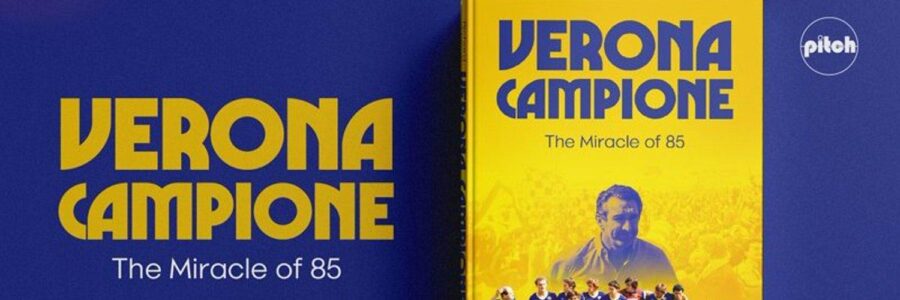
Verona Campione – Richard Hough
Richard Hough is the Scottish author of a new book, ‘Verona Campione.’ It is the story of how Hellas Verona became Serie A champions in 1985, published to mark the 40th anniversary of the achievement. I spoke to Richard about the book, the club and how the Scot came to call Verona home.
When I spoke to Richard, Lewis Feguson had just lifted the Coppa Italia whilst Napoli’s Scott McTominay and Billy Gilmour were sitting pretty, at the top of Serie A. Add in Liam Henderson, Josh Doig, Che Adams, Christy Grimshaw and Lana Clelland, and Scotland have a strong footprint in both men’s and women’s football on the peninsula. How does that make a Scot living in the country feel?

Scottish invasion
“I consider myself so fortunate to be here during this golden age of Scottish players in Italy. For decades there were very, very few Scottish players and now suddenly, there is a lot. They are also having a massive impact. As a Verona fan when Henderson arrived, I was just over the moon. He was the first of the current wave. It was just amazing to have a Scottish player playing for your local team in Italy, the first one since Joe Jordan. Even though Jordan only played maybe twelve games and scored a couple of goals for Verona, he is still highly revered here. He had a massive impact in Verona because of his personality. I think also because he was missing his front teeth. They call him ‘lo squalo,’ the shark. And even to today, I meet people and tell them I’m Scottish and the first thing they say is ‘Joe Jordan.’
Even the players I have spoken to for writing this book, all remember Joe extremely fondly. There is something about Scottish players that gets people excited. They expect the Scottish players to have a bit of passion and fire. I guess also because they are quite rare breeds as well over here. It was just Denis Law and Joe Jordan for the longest time, now this new wave is just absolutely bossing it. You know, you have got Scots on the front page almost every day now.”
Tell them we’ll go
It was obviously football that brought Law, Jordan, McTominay and Ferguson to Italy. However, it was not the beautiful game that brought Richard to the peninsula.
“My wife is of Italian origin as her parents are both Italian. We had always considered moving over here at some point. She was working for a pharmaceutical company in Edinburgh who acquired part of a company over here in Verona. She was going back and forward between Edinburgh and Verona for a while and then they transferred several of their staff over to Italy. So, I got a call from her one day asking what I thought about moving to Verona.
I never knew much about the place. I studied Shakespeare, Romeo and Juliet at school. Apart from that, I did not really know anything about it. I left work and went out to a bookshop and picked up a Verona guide book. Leafing through it and seeing pictures of the lakes, vineyards, piazzas, and the beautiful city and culture. There was a little couple of paragraphs about the football team as well. I just thought ‘this sounds fucking amazing’ and got straight back on the phone to say, ‘Yeah, tell them we’ll go.’

1990 World Cup
The couple of paragraphs about the football that Richard had read in the Verona guidebook may not have been his main reason for saying yes to the move. He was a fan of the game in Italy though and like many fans of certain age in the UK, it was the Channel 4 coverage with James Richardson that informed his experience of Serie A.
“I was always a completely crazy football fan. Obviously, the 1990 World Cup was influential as I was 14 at the time. After that, James Richardson’s programme was really influential as well. Probably like most people, it wasn’t necessarily the football matches that drew me to it. It was this image of James sitting in a sunny piazza with an exotic looking newspaper and a coffee. It was a lifestyle that just looked amazing. The football always seemed a little bit different, but not always necessarily in a good way. There was something about it that I was never quite convinced by, but it was still very much on my radar. I certainly did not know much, if anything, about Verona, Hellas Verona or Chievo.”
Central to my life
“I started going to games pretty much straight away when we moved. Tim Parks (author of ‘A Season with Verona’) spoke to me once and I remember he said, “Football is there for you when you need it.” I was a Scot relocating to Italy with no friends or family here, other than my wife and my son who was three. I could not speak Italian and had no job at first. Football really filled a massive hole. It gave me the community that I needed. Going to the bar and watching English or Italian football, making friends in there. I formed some close friendships and met some really interesting people.
Then by going to the stadium as well, football really has just given me a sense of belonging and a sense of community. Also with my kids, you know, I took my oldest son for years on end, and now I go with my youngest son and his pal. It is a community thing, but also as father and son as well. It has been central to my life here.”

Notes from Verona
Richard’s passion for writing started at a young age. His studies meant his writing went from football stories with his brother as youngster, to writing about the Second World War. His move to Verona saw him write a series of essays on life in Italy which he published as ‘Notes from Verona: An Anthology.’ He also penned two volumes of ‘Verona at War.’
“I have always really loved writing and telling stories. I remember with my twin brother, being about six or seven and we would produce our own version of Roy of the Rovers. When I came to Verona, I started researching and writing about the history of the city. I started blogging and writing and it just became a way of learning about the city I was living in.
As I got more and more drawn into the Verona scene as a fan, I began to do some writing with The Gentleman Ultra and a couple of pieces in the Guardian. I have always felt that Verona has a bad reputation, but it also has some pretty amazing stories to tell.”
Amazing achievement
Perhaps the greatest of those stories is Verona’s famous league title win in 1985. As the 40th anniversary of the victory approached, the idea for Richard’s book was born.
“The 40th anniversary of the Scudetto was approaching. I was in the pub with a friend of mine who is a correspondent for the local newspaper here. I told him I was thinking I should write a book in English, for the English market, to talk about this amazing achievement. It seemed like the perfect moment to write a book to tell that story and that was basically the origins of it.”

Miracle of ’85
“The sub-title of the book is ‘The Miracle of 85’ but it is a bit unfair to call it a miracle. It was a project that began in 1981 with the appointment of Osvaldo Bagnoli as coach. Over the next three seasons he brought in players, a couple of whom were discarding from the bigger clubs. He built them into a championship winning team. It was a period of unprecedented levels of achievement including back-to-back Coppa Italia finals and a great European run before the 84/85 season. They were still a team that no one ever thought in a million years could win the championship.
I knew a lot about the club and its history. Some of the key players and some of the key moments. Nothing like enough to write a book about it, so there was a very extensive phase of research and conversations with players, fans and people who are around at that time. Evenings were spent in the archives and it was fascinating going back and looking through newspapers from the mid-1980s. There was a lot of research involved and a lot of speaking to the players and to the fans. The biggest challenge was trying not to get drawn into rabbit holes. There was so much going on in world football and in particular, Italian football at the time. Some of the greatest players were playing, like Maradona and Platini.”
Marking Maradona
Research can bring up the results and statistics of the time. When it comes to football fans, a winning team often brings characters that may not show up in the stats. The fan favourite, cult heroes don’t always jump out from statistical records so I wanted to know if any such character showed up in Richard’s conversations with players and fans.
“Statistical records can help but what I really wanted to do was to try and capture a sense of the emotions, the sights, the smell, and the colour. At one point I found myself sending a message to a couple of players when I was writing the account of the first match of the season. It was against Napoli and it was Maradona’s first game in Italy. I thought right, where do I start this story? I realised at one point that there would have been a conversation during the week of the game about who was going to mark Maradona. That was a good place to start and Hans-Peter Briegel stood up and he volunteered for that job.”

Smell of adrenaline
“The other thing I wanted to know at this point was, what did it feel like to be in that dressing room? What did it smell like to be in that dressing room? So, I sent a message to the players saying, this is a strange question, but can you tell me what it smelled like in the dressing room before the Napoli game? To their credit, they got back quite quickly. These guys can remember the details. One of them comes back to me with the smell of camphor oil. I had to look that up but it is like the vapo rub that we used to use as kids. The other player just said adrenaline, and I thought that was brilliant. You are now brought into this changing room and you can imagine it. The noise coming from above, the smell of camphor oil and adrenaline.
The one player that I feel like is the most closely associated with the with the championship is Preben Elkjaer, the Danish striker. He more than anyone else represents what Verona achieved that season. He was the striker and he scored some of the most important goals. But the thing to emphasise is that there were no superstars in that team. It is what the manager Bagnoli insisted on. I heard Pietro Fanna, another player, talking about playing in a benefit match about ten years after the Scudetto win. He said they players still had that almost telepathic connection. He said he had never played on a team like it. They could just instantly go on the pitch and know exactly what they were each going to do. So, it was an incredibly close group.”
Cult status
Richard’s latest book will undoubtedly raise interest in Verona from those outside the club. It already has a place in the footballing heart of many who live away from Italy as the book’s author has seen in and around the Bentigodi Stadium.
“Verona, because of Tim Park’s book, already has a bit of a cult status. More or less every home game you get groups of English or Scottish fans in the ground. There is a big group of Aberdeen fans that come regularly and a group of guys from Portsmouth. People who get fed up and have abandoned the Premier League because it has become too expensive, the atmosphere is going kind of stale and corporate. They come over to somewhere like Verona for an old school experience where they can get good, cheap tickets compared to the Premier League. You can smoke and drink on the terraces and they don’t have to sit like the more sanitised Premier League. They have a great time and they come back year after year. I think Tim Park is one of the main reasons Verona has that kind of cult status.”
Verona Campione is available to but now – https://t.co/ZC7y3kbuSK