

Derek Rae – The Voice of Football
Derek Rae has one of the most recognisable voices in football. His commentary has featured on match coverage around the world. He has covered major domestic and international competitions since starting out as a commentator in the 1980s. A new generation of football fans recognise him as the voice, and face, of the video game FIFA. It all started on an Aberdeen putting green over 50 years ago.
“The one day that stands out was in the early seventies when my dad took me down to the putting green at Aberdeen Links. The putting green that used to be there was right opposite the Beach End of Pittodrie. Aberdeen were playing Dundee United that day. I don’t think he had planned this but, in those days when a match got to half time, they would just open the gates. People could come and go so you could just walk in.
We finished our putting and it was half time in the game, my dad asked if I wanted to go and have a look. I said yes and I just remember walking into the Beach End and everything was three-dimensional and in technicolour. I had only ever seen Aberdeen in short television highlights on a black and white television. Aberdeen won the game three-one and I loved it. We ended up going to the next home game, which was against Clyde. It just became a regular part of my life after that.”
Talking about football
His professional commentary career may have begun in the mid-1980s but Derek was adding his voice to matches long before he made it his job.
“I realised at a young age that I enjoyed talking about football as well as watching it. The 1974 World Cup was quite instrumental in that. I had a voice recorder at that time. The young people of today won’t realise but that was quite a special thing to be able to record your own voice and listen to it back. I would watch games in the 74 World Cup and record myself talking or commentating on them. The tournament was in Germany. Although I didn’t know it at the time, that sparked an interest that would become a big part of my life. I still have a tape of myself doing commentary on that World Cup.
I used to do my commentary on games that were being played in the park or on the street. Eventually, I took my recording device to Pittodrie for reserve games and then first team games. There was an area at the front of the stand that I found for myself and I would just commentate on the games as I was watching them. It wasn’t a job that school teachers would talk about as a possibility but it was always in the back of my mind that it was something I would like to do and if I was really, really lucky, I might make it a job.”
First break
There was no luck in what led to Rae’s first break in the industry. He approached a man that he looked up to as a commentator. That approach ended in a friendship with the man he called a hero of his, as well as his first live match commentary.
“At that time, you could probably count the number of professional commentators in the UK on two hands. It was very uncommon to do it for a living. I had established a long-distance friendship with my hero at the time, David Francey. He was the voice of Radio Scotland football at the time. I had initially sent David a tape of one my commentary recordings. Much to my surprise, about a week later I received a beautifully penned letter from him.
He told me that he had listened to my tape, he offered a few words of critique and encouragement and we stayed in touch. He advised me to get involved in Hospital Radio to gain experience, which I did. That was a common route into broadcasting back then.”
Like what he heard
“I had sent another tape to David and rather than reply to me he had passed it on to his boss at the radio station. His boss got in touch with me and invited me down to Glasgow for chat. During that conversation he told me that he liked what he heard and that he would like to put me on air. My first game was Aberdeen against Celtic. I never commentated that day but I was a reporter providing updates on the game.
About three weeks later I got a call on a Friday asking what I was doing the following day. There was a bit of a crisis as David was unavailable due to a knee injury. They asked if I would like to commentate on Kilmarnock against Dumbarton the next day. They put me up in a hotel in Kilmarnock, it was the first time I had ever been there. The commentary seemed to go well and I left with a good feeling about it.
When I got back to Aberdeen I was asked to call the man in charge, Charles Runcie. He said he liked how the game went and asked if I would be available to commentate on England versus Scotland that upcoming midweek. It was 1986 and I found myself at Wembley commentating on England against Scotland, the oldest game of them all. I was nineteen and it was my second ever radio commentary.”

John Greig
Derek moved quickly from radio to television coverage. That saw a transition in style as he moved from one format to another. There have been many changes in the role since, not least in the position of co-commentator. Rae has fond memories of the Rangers legend who was his first partner in the gantry.
“The basics are still the same whether it is radio or television. On radio it is more descriptive as you need to be the eyes of the listener. TV is different, the viewers can see the game so we are doing a bad job if we just simply tell the audience what they are seeing.
Another change has come in the role of the second commentator or co-commentator. My first co-commentator at Radio Scotland was Rangers legend John Greig. I worked alongside John for a good chunk of my five years with the station. He was almost like a dad to my in some respects, mainly the age difference. John was always nice to me. I learned a lot about the game from him. Back then the co-commentator would say very little. Nowadays it seems almost to be one line from the commentator then one from the co-comms and it is more like a conversation. It was not like that back then. The co-commentator would just come in every so often with some thoughts rather than making comments on incident in the game.”
Research
One thing I was eager to ask Derek about was the information sheets he writes up prior to every game. He has posted pictures of them on social media in the past and I found the detail and volume of information in them fascinating.
“It is laborious but I have never found a better system for me. Every commentator will tell you that they have found a system that works for them individually. I hand-write everything because as a language student, I found that writing things down implants them in the memory far better. I have the same system for every game and it is all colour coded.
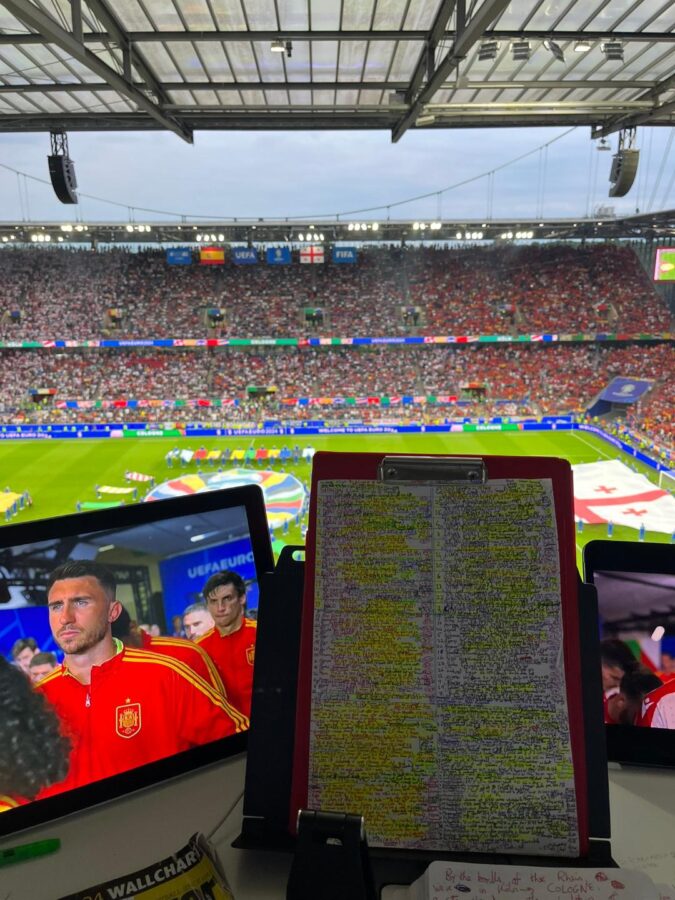
Each team would be written in different colours, home team on the left and away on the right with the page divided down the middle. The top half I will write the players and will have my lines on each player. It is often the same information from game to game but by writing it out each time helps it stay in my mind. I have different sources in different countries depending on what league I am covering. The final product is this bit of paper with tiny writing that nobody else would possibly be able to understand.”
German football museum
“People who see them often ask how I manage to read the writing as there is so much of it. When you are commentating you don’t really get a chance to read much of anything. You concentrate on the match and if it is a televised game we need to watch the live action and what is on the monitor at the same time. You need to look at that monitor so you know what shot is being shown to the viewers at home so I can make what I am saying mesh with the footage that is going out. The notes are there more as a learning tool for me to use in the lead up to a game.
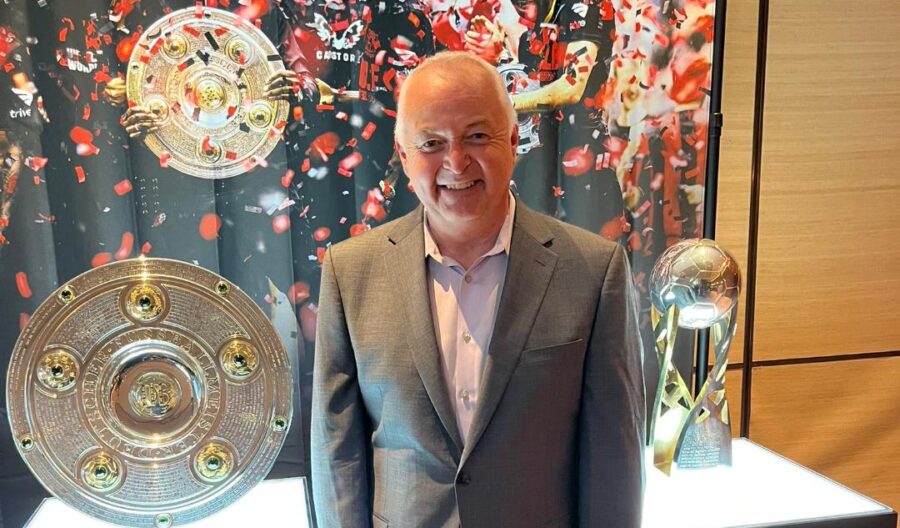
I keep most of them. I did a big clear out a few years back as there was getting to be too many of them. The past seven or so years’ worth I have. There are special games that I will keep to one side and maybe frame someday. There is one in the German football museum in Dortmund. They contacted me and asked if I would be willing to donate my team sheet for when Leverkusen won the Bundesliga for the first time in their history last season. That one has pride of place in the museum and I was more than happy to give that one up.”
FIFA 19
It is not just to radio and television that Rae has leant his voice. EA FC, the video game previously known as FIFA, has opened Derek up to a new set of fans.
“If you speak to anyone under the age of about 25, they would know me purely from the video game. It is probably the most high-profile thing that I have done in my career. I was approached in 2017 to do FIFA 19 as it was at the time. I have been part of it for every game since then. It is EA FC now.
As a commentator you don’t really get stopped by people. They might know your voice but I’ve always has a quiet life from commentary. I don’t live in Aberdeen anymore but I try to get back for games when I can. The last time I was there it took about half an hour to get out the ground. I was getting asked for selfies or to recite lines from the game. It has been explained to me that the game is how many young people have grown up with football rather going to games or watching on tv. The game is a huge part of many people’s childhood and into adulthood. It is a privilege for me to be involved in that.”
Jelly legs
I could not let Derek go without asking him which of his many commentary matches were his favourite. He picked two high-scoring classics to which he provided his inimitable narration.
“The 2005 Champions League final in Istanbul between Liverpool and AC Milan. I was lucky enough to cover that game for ESPN. That went out on North America, parts of Africa, Australia and other countries too. Liverpool were three down at half-time of course. I was looking up to see what the record scoreline was in the final but what happened was a commentator’s dream. Liverpool came back to take it to penalties and then win it.
Jerzy Dudek was copying Bruce Grobbelaar in the ‘84 final which I remembered watching. When I think back to that commentary, I am most proud of that line. I saw Dudek doing the ‘jelly legs’ and another commentator may not have known the relevance and not mentioned it. In my commentary I said that ‘it’s almost like he is channelling his inner Bruce Grobbelaar.’ I then explained what that meant as people watching in America may have had no idea who Bruce was. It was an honour to be at that game. It may not be bettered in my lifetime as a final of a major competition.
The other game that stands out from around that time was Dortmund against Schalke, which is a big derby match. It was 4-0 to Dortmund at half-time. I love to commentate from Dortmund and have been lucky to commentate there many times. That day Schalke pulled it back and with virtually the last touch of the game Schalke made it 4-4. It was incredible.”
You can hear Derek’s commentary on ESPN, EA FC and follow him on Bluesky at the link: https://bsky.app/profile/raecomm.bsky.social