

Clive Tyldesley – Top of the Commentary Charts
Clive Tyldesley has lent his voice to some of the most memorable moments in football. As a commentator for both BBC and ITV he has covered numerous World Cups and European Championships in addition to domestic and European club competitions. It was Clive’s project away from the microphone that caught my attention lately. His Commentary Charts have become a must-have souvenir for football fans.

Commentary Charts
I wanted to find out more about this and Clive’s career behind the mic so we started with his Commentary Charts.
“Commentary Charts began, as so many things did, during Covid. I was compiling handwritten charts for games right from the beginning of my career in commentary. During Covid, just for amusement as much as anything, I was refiling all my charts. Each day I set a quiz question where I covered up a name on a chart from a famous game. People offered their replies based on the biographical information next to the blanked out name. A good friend of mine is Chris Stark, who hosts the Peter Crouch podcast. The Watford chart, that is his team, was featured one day and he said ‘I’d love a copy of that.’ I said he could have it but he said he wanted to buy it from me. He said ‘you should sell those, people would love them.’ And so, we started up Commentary Charts with prints of literally four games.
The Champions League finals that I had commentated on happened to get some interests from, I think initially, Gary Neville and Jamie Carragher because they were they featured on the charts. They posted them on their social media accounts and suddenly we had a business and were absolutely swamped with inquiries. We developed it over the course of the last two or three years from games that I actively worked and commentated on. We began to get requests from fans of other clubs for iconic games in their histories and my initial reply was ‘well they were not my games.’ They replied by asking if I could still make a chart anyway.”
John Motson and Sir Alex
The original purpose of the charts was to assist Clive with some details and statistics which he could drop into his commentaries. They have since become a reminder of games which both supporters and players alike have been keen to get their hands on. Tyldesley told me there was even interest from a famous managerial name.
“It was an idea stolen from the late John Motson. He compiled his own charts in a very, very similar style and had terrifyingly neat handwriting, rather like me. I got to know him quite early in my career. Whenever he came into town to commentate on a big game for television, we’d have a bit of supper and a couple of glasses of wine the night before. I probably stole the idea from him. I was fortunate enough to commentate on both of Sir Alex Ferguson’s Champions League victories with Manchester United. Sir Alex, with a very generous donation to a charity that I am a patron of, bought the original commentary sheets from both 1999 and 2008. He had them framed in his office, originally at the Cliff and then the Carrington training centre. Anybody who went to that office, their attention was drawn to these commentary charts.”

Totally invested
“So, they do mean something to the participants. Bryan Gunn is a very good friend. He has been, as we say in northern England, mothering me for ages to do an Aberdeen chart for their Cup Winners Cup final. I know big Alex McLeish very well I know wee Gordon Strachan. I couldn’t tell you where I watched that game but I remember I did watch it. A lot of my recollections are from what I’ve seen in recordings of the game in subsequent years. It was a very famous final and a glorious victory. We became more ‘Ferguson aware’ in England three years later. I’d kind of revisited some vague memories in researching the game in the depth. I was looking back through old newspaper cuttings and trying to collate as much of the information of the day as I could. I watched videos, not just of the final but of the build-up games and all the games that led to the final. For the three or four days that it took to compile it, I became totally invested and was living really in 1983.”
Eastern Europe
The internet makes research a far less ominous prospect these days than it did for Clive when he first started compiling charts over 40 years ago. I was interested to know how he went about learning facts and figures without the convenience of the internet.
“I’ve got so many memories of the lengths that I went to try to find out information. Eastern Europe was like Neptune in the 1980s in terms of trying to get information. I remember one trip that I did with Liverpool to Lodz in Poland. I managed to get in touch with the journalist there via a Telex machine we had in the corner of the office. This guy sent me chapter and verse on the Polish side, player information that I couldn’t possibly have found anywhere else. He came to stay on Merseyside and we invited him to stay at our house the night before the game. It was just as well because whilst he travelled with the team to England, he had no currency that would have been acceptable here. US dollars were all they had really, if they were traveling abroad.”

Bit of a challenge
“He invited me to his home the evening before the second leg in Poland. I had been on the Liverpool coach and recall pulling up at the team hotel. There was a queue outside and a couple of the players were moaning because they thought they were autograph hunters. It was a bread queue. They weren’t interested in Liverpool, they were worried about where their next meal was coming from. I went for a meal that night with this reporter and his family. I remember there were five of us sitting around the table. There were nine pieces of meat and they had one each and they put the rest on my plate. That was covering European football in the 80s.
Now, I can watch a tape of any team in pretty much any league. I can watch all their league games and I can easily get in touch with reporters and commentators in those countries. North Korea at the World Cup was still a bit of a challenge, but that is about as difficult as it gets.”
People can turn you down
Clive has commentated on television and radio. I have often wondered how different a commentator’s approach is to each medium. Does the research differ depending on whether the commentary is for radio or television?
“I’m often asked about that as I do quite a lot of work with media undergraduates. My answer is very straightforward. In television, you are just not as important. You have got to get your head and your ego around that right from the outset. It is a picture medium. People can turn you down or probably find an alternative commentary source these days. The most important single individual at a television outside broadcast is the match director. That is the man or woman who is deciding which camera angle you see on your TV screen, tablet or however you’re watching the game. We follow them or we should do.”
From the heart
“If there is a skill to what I do, it is that I am listening to them talking to the camera operators at the same time as I am talking. So as a television commentator, I think it is more a test of concentration. What can you add to the experience for the viewer, how can you augment it. It is how you embellish it to bring extra understanding and background to the game that you’re watching. I think it is a test of your head.
I think radio commentary is more from the heart, you plug in and go. You are the listener’s eyes and so the prep is very similar but how you use it I think is very different. On those commentary charts, I am trying to cover all the bases. If I use more than 10 to 12% of the information on those charts, I am probably boring the television viewer and probably indulging myself. It is like saying ‘listen I bloody well done this research and you’re bloody well going to hear it,’ which is not good commentary. The great commentators in sport have been famous for silences as much as anything they say. The timing, the rhythm of the commentary is really, really important.”
Co-commentators
Another important component of any match commentary is the co-commentator. Clive came to prominence for me during his coverage of Manchester United in the Champions league during the 1990s. His commentary was memorable, as was his relationship with co-comms of the time like Ron Atkinson and Andy Townsend.
“Back in the 1980s there was a different relationship, a more intimate relationship between everybody. So, I think with those relationships, you can’t force them. You can’t invent them. There has to be some personal warmth and friendship. I’ve been so fortunate in my career. Ninety-nine percent of the people that I’ve worked with have become firm friends. Ally McCoist is an obvious example in more recent times.
I was commenting on Aston Villa versus PSG recently and bumped into Andy Townsend in the media room. There were no handshakes. There was a big hug, you know, they’re really, really good friends and hopefully that relationship is transmitted on the air. I think there is a danger of becoming over familiar with your co-commentator. I’m not a great fan of what the Americans call the three-man booth. I mean TNT now use a standard three-person commentary team. I think there is a danger in those circumstances that they start to talk to each other and that you kind of feel like somebody who is listening into a conversation, rather than part of the broadcast. You lose a little bit of that intimacy. That is just my personal opinion.”

You’re all mad
Take to social media during any live match broadcast and you will find someone claiming that the commentator is biased. It appears to be an occupational hazard so I wondered how many teams has Clive been accused of supporting in the past.
“The reason that I have this job is because during a football match, you’re all mad. You’re not yourself and most of your balance, reason and judgment goes out of the window. As the commentator, you’ve got to live with that because that is the power that keeps you in the job. That is the level of committed interest that people have.
I was brought up as a Manchester United fan and lived in the Manchester area. My dad took me when I was four or five years of age. I went home and away in my teens. Only six months into starting my dream job at a local radio station in Nottingham, I was covering Nottingham Forest. I was the same age as players and at that time the relationship between football and its media was very close. I travelled on the team coach and I was down at the City Ground most days trying to get interviews. When we got back after a game we’d all got out and have a few lagers together. Manchester United kind of left me. I can’t explain that to the fan of any football team, how on earth can you be neutral? Well, I’m sorry but I know in my heart that I am neutral. I have got a lot of friends in the game and I support my mates.
I didn’t like him very much
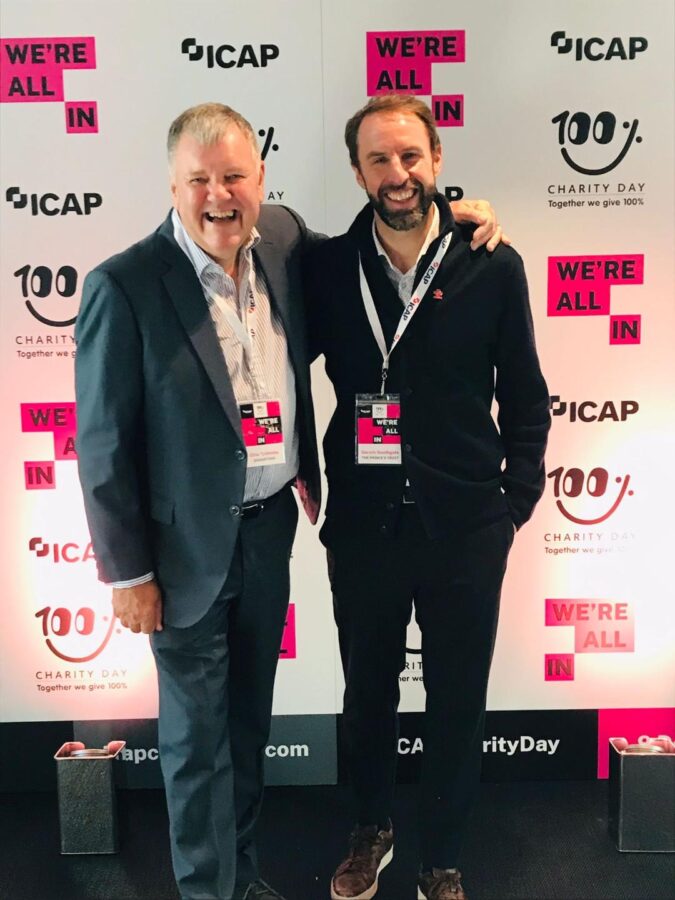
“It’s funny, I’ve had a bit of contact with Gordon Strachan in the last few days over the Aberdeen chart. We’ve always had an interesting relationship because I didn’t like him very much when I first met him. He was a nightmare to interview. He was so damn clever and knew it, so I didn’t like him very much from a distance. Then one of my best friends in the game, Sir Gareth Southgate got the sack at Middlesborough. Strachan got the job and I wanted him to lose every game. I’m sorry that is how you react when your mate gets the sack, you want whoever replaces him to be a disaster. Then I got to know Gordon and we played golf together and became firm friends. Of course, everything I’ve just said to you I said to him and he found it hilarious. It was exactly what he was trying to do, wind up people in the media.
I did an England Scotland game at Hampden between Gareth and Gordon and both trusted me with their team selections. They knew that there was no way I would share the information with the other. The information was just for me and helped my preparations for the game.”
No regrets
I ended the conversation by asking Clive to look back, but not at the games he commentated on. I wanted to know if there was a game that he never worked on that he would have liked to cover. He wasn’t allowed to choose 1966 World Cup final as I presumed he may opt for that.
“Since ITV gave me the elbow, it’s been nearly every England game. I’m a great believer that football belongs in the moment. You remember where you were, who you were with. So professionally with the games that I’ve worked on, I would never try to nominate a best game. I suppose because Gareth is a friend and because that job was taken away from me before the two finals, I’d love to have commentated on one of my friends leading my nation in a major final.
I probably feel that I’ve had the best of it in the timing of my career. That era that you talked about, the close relationship in the one TV per household days when people actually listened to the commentary and were involved in the game. I’ve got no regrets. I’ve been a lucky boy.”
Find out more about Clive’s Commentary Charts at the website – https://www.commentarycharts.com/